
Arm Lift vs Liposuction: The One Question That Decides It
Every week I see patients who've spent months researching arm contouring and still aren't sure whether they need an arm lift, liposuction, or both. The confusion is understandable — the internet gives you lists of differences without ever giving you the single clinical principle that makes the decision obvious. Here it is: the procedure is determined by what's causing the problem, not the problem itself.

The Pinch Test: Your At-Home Starting Point
Before any surgical consultation, you can perform a simple at-home assessment that gives a reliable initial indication of what's actually driving your arm concern. This is the same starting point I use in every arm consultation — refined, of course, by a thorough in-person examination.
How to do it: With your arm relaxed at your side, gently pinch the tissue on the underside of your upper arm between your thumb and forefinger. Hold for 2–3 seconds, then release and observe carefully.

If you have a significant amount to pinch and the skin doesn't recoil well, you likely have both excess fat and skin laxity, and a combined approach will give you the best result.
Three Arm Profiles: Which One Are You?
The key question is whether your main concern is loose skin or excess fat, as each procedure targets different issues. Visually, this breaks down into three distinct profiles:
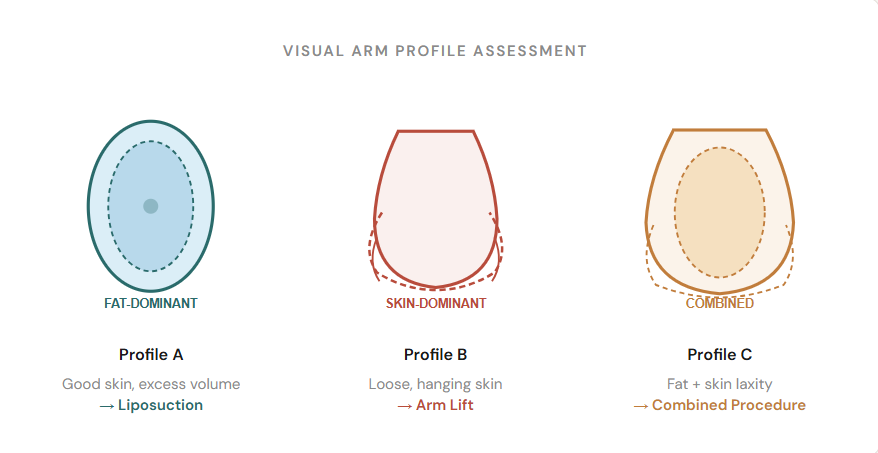
The Decision Framework
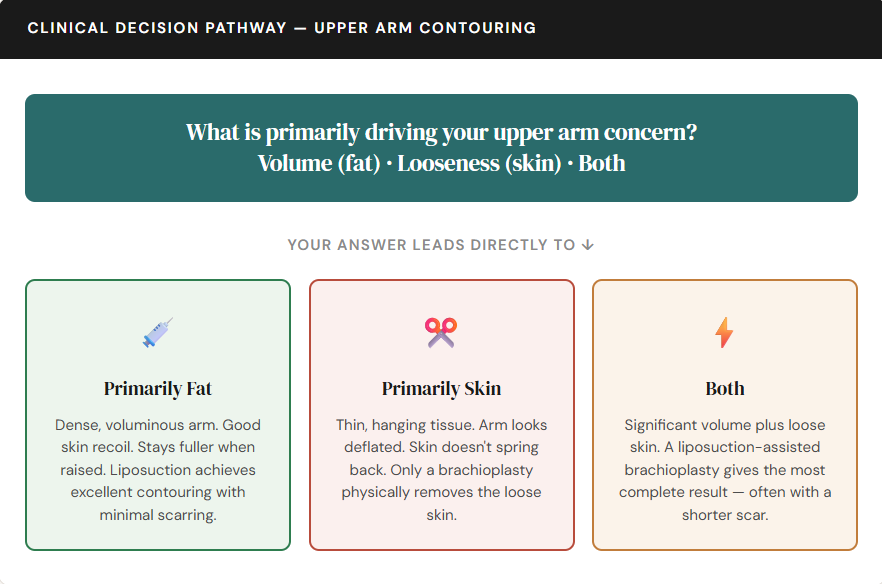
Arm Liposuction: Who It's Right For
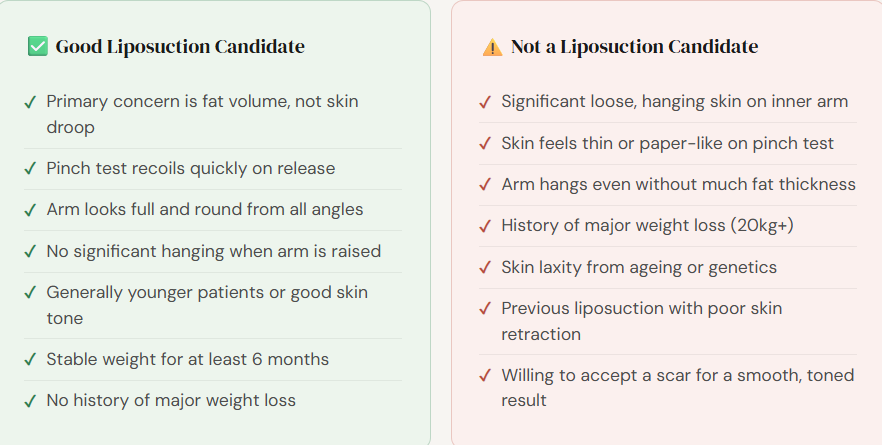
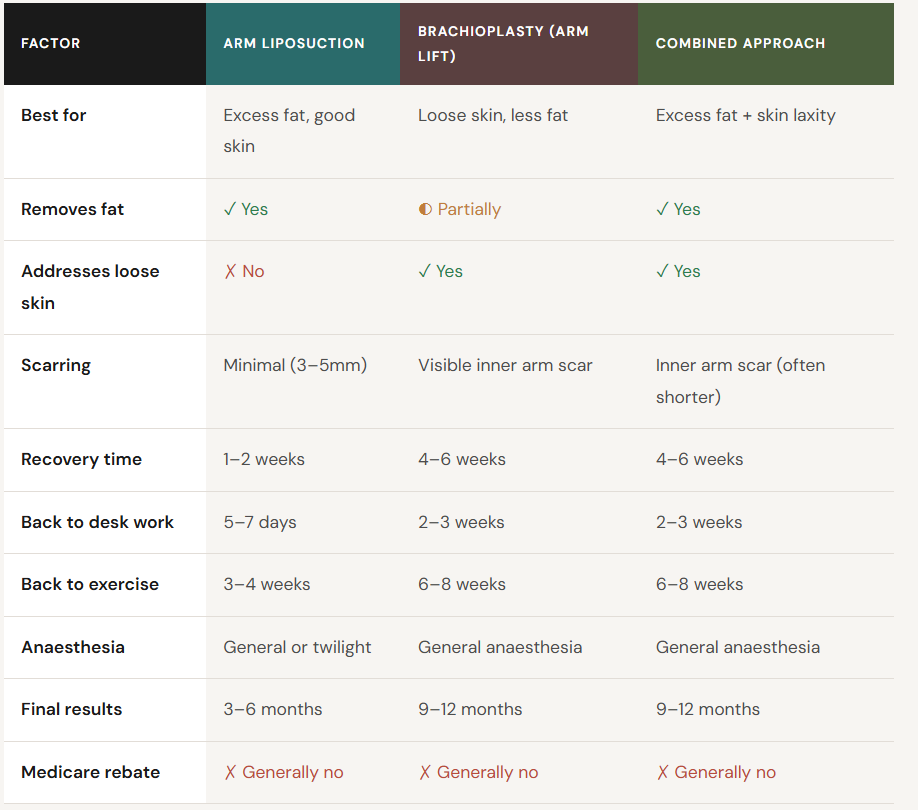
Arm liposuction is a good option for patients who have stubborn fat deposits resistant to diet and exercise, and it is performed using a small, thin cannula inserted through tiny incisions in the arm. The result is a slimmer, more defined arm with minimal scarring — typically 3–5mm incisions hidden in the armpit or elbow crease.
The critical requirement is good skin elasticity. Patients with firm, responsive skin are typically the best candidates for arm fat liposuction. After fat is removed, the skin must have the ability to contract and conform to the new arm shape. If it lacks sufficient elasticity, the result will be an arm that looks loose and deflated rather than toned — the most common cause of disappointment from arm liposuction.
Arm Lift (Brachioplasty): What It Can and Can't Do
An arm lift, or brachioplasty, is fundamentally different from arm liposuction — its primary purpose is to remove loose, hanging skin that will not tighten on its own, most commonly after significant weight loss or where skin elasticity has declined substantially over time.
The procedure involves an incision running along the inner (medial) upper arm — typically from the armpit toward the elbow — through which excess skin and often some fat is removed. The result is a dramatically smoother, tighter arm contour. But there is a scar, and it should be discussed honestly.
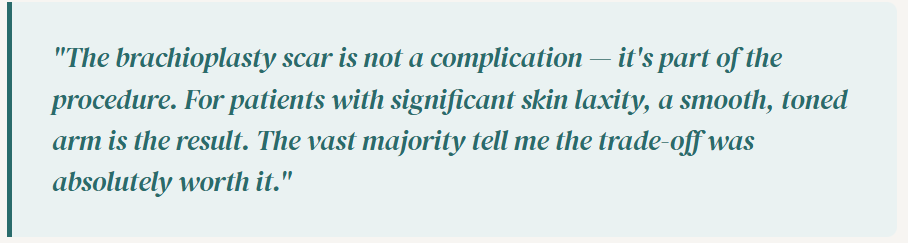
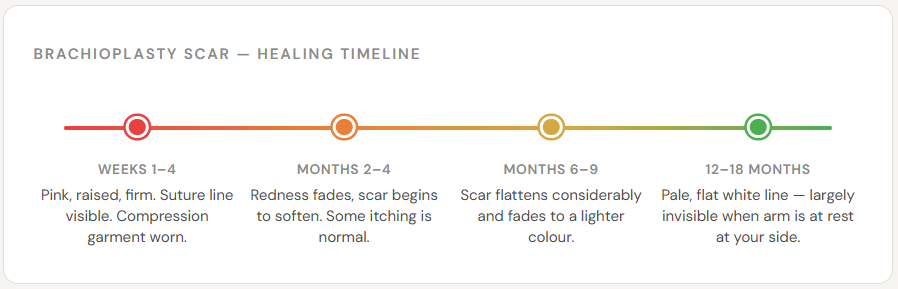
The brachioplasty scar is located on the underside of the upper arm, where it is less visible. Initially pink, it will gradually lighten and soften over time to a flat white scar for most patients.
Side-by-Side Comparison
Frequently Asked Questions
Can arm liposuction fix bat wings?
For patients with good remaining skin elasticity but excess fat, liposuction may be the more appropriate option. For patients with loose, hanging skin, an arm lift is recommended. If bat wings are caused primarily by skin laxity — common after weight loss or with ageing — liposuction alone will not resolve the problem and may worsen the appearance by removing volume under already-loose skin.
I've had significant weight loss. Do I need a lift?
In the vast majority of post-weight-loss patients, a brachioplasty or combined approach is needed. Significant weight loss stretches skin beyond its elastic capacity, meaning it won't contract after liposuction alone. I generally recommend waiting until weight has been stable for at least 12 months before arm surgery.
Can arm surgery be combined with other procedures?
Many patients opt to combine brachioplasty with other body contouring procedures such as abdominoplasty, liposuction, or breast surgery — combining procedures offers a more comprehensive transformation, saving time and cost. Feasibility depends on your health, planned procedures, and estimated operating time, all assessed at consultation.
How do I know if I'm a candidate?
Start with the pinch test above. Formal candidacy requires an in-person consultation to assess skin quality, fat distribution, health history, and your goals. Good candidates for any arm procedure are at a stable weight, are non-smokers (or willing to stop for at least 6 weeks before and after surgery), are in good general health, and have realistic expectations.
What's the difference between a mini arm lift and a full brachioplasty?
A mini arm lift (short-scar brachioplasty) uses an incision limited to the armpit area — suitable for patients with mild to moderate skin laxity confined to the upper portion of the arm. A full brachioplasty uses a longer incision from armpit toward the elbow and is appropriate for more significant or lower-arm laxity. The right technique is determined by where the loose skin is and how much needs to be removed.